skip to main |
skip to sidebar
All photos of the Jupiter Hammerheads and GCL Cardinals games available on Flickr.
Erik and I spent 3 days in hot and sweaty South Florida, and we can once again count ourselves among those devoted baseball fans who have been to all 30 current MLB stadiums! Not before we squeezed in some minor league ball, however. Our trip began on Thursday with an early flight from Milwaukee to Fort Lauderdale. The plan for the first day was to rent a car and drive up the A1A (Beachfront Avenue!) to Jupiter to catch a game at Roger Dean Stadium. When looking for cars to rent, I snatched up the opportunity to drive a convertible for quite possibly the first and only time in my life. It was one of the cheaper rental options for some reason and we got a black Chrysler 200. I don't know anything about cars but I thought it was pretty sweet ride, although it was no Yeller. It took us awhile to figure out how to put the top down but by about 4pm, we were off. The A1A ended up being a very slow ride up the Atlantic coast and we did not have the luxury of time on our side as we did on the Tour to cruise down the PCH, so we unfortunately had to switch over to the interstate. We checked into our hotel a few miles from the park and got to the gates at what we thought would be just in time, but it turned out the game was at 6:30 and not 7, so we were a little late. Arriving late proved to have some benefits though. We didn't feel rushed to get inside and got to see most of the exterior, and Erik was able to find a foul ball outside since the game had already started. The guy in the ticket booth for some reason generously gave us the child/student rate and we finally walked into the park in the bottom of the 2nd.
 I was shocked right away with how many people were in the concourse. Knowing that Florida State League games are frequently roasting hot and/or rained out, we were expecting a very small crowd on a weeknight. In our only other FSL experience in Dunedin, it was so empty and quiet we could hear people coughing on the other side of the stadium. It turned out the Hammerheads drew a great crowd of well over 1,000 for Dollar Dog Beer & Soda night. We went to our seats for a few innings before getting food in hopes the lines would die down, but such was not the case. Between arriving to the park late and waiting in the concession line, I probably missed a third of the game. The fact that the Hammerheads only had 3 small carts open for $1 dogs led me to believe that the large crowd was in fact an anomaly, because clearly they were not prepared for this many people. The concessions and the concourse were a joke. The lines were terrible for everything and there were food carts instead of proper stands, so the food lines cramped into the aisle way, and it should have went much faster since everybody was just getting hot dogs and beer. There was also only one spot in the right field corner that had handicap access up to the seating bowl and only one set of bathrooms that I found. The one nice part of the concourse was there was a pretty good team store that had plenty of gear from both of the FSL tenants, as well as their parent clubs who use "The Dean" in the Grapefruit League (Marlins and Cardinals).
 The outside of the park certainly had a Florida-esque flare with its use of colors, archways, stucco, and many palm trees for shade. But the inside was not unlike any other minor league park of its size. FSL parks are sort of unique because as I mentioned, they often double as Spring Training sites. At Roger Dean Stadium, you will find a nice jumbotron, nice clubhouses, back practice fields, prominent team offices, and a larger seating capacity than you might see in any other A-ball league, and I'm sure several other FSL parks are the same in this regard. I was kind of surprised that there were not more fan amenties since it does also get used for Spring Training. It certainly was not a bad experience but the most memorable part of the night for me was the game itself, not a fancy stadium. I guess many baseball purists would argue that this isn't necessarily a bad thing.
 Erik and I have been to so many ballgames now, that they all kind of blend together for me after awhile. Erik tends to be much more attentive to the actual games than I am, whereas I care more about the architecture and experience of the ballpark. There are those games once in awhile though that I can't help but remember, and Thursday night's game was one of them, despite only seeing 6 innings of it. Christian Yelich and Jacob Realmuto both went deep twice and combined to knock in 10 of the team's 11 runs in the win over the St. Lucie Mets. It was definitely the most homeruns I've ever seen in a minor league game, and probably also the most hard-hit balls I've seen. Lots of balls to deep center and line drives in the gap. Between college summer ball and the Brewers I haven't exactly been seeing a lot of high-talent ball lately and it was very refreshing to be there for this hitting display. Yelich also chipped in 2 singles on the day to finish 4-5 and Erik has informed me that he is playing in the Futures Game next week during the All-Star Break. Marcell Ozuna, the league-leader in homeruns, did not run into one tonight but did have a hit. The future looks bright for the Marlins if these kids can keep it up and they don't get traded. Both starters only went 5 innings but the Hammerheads starter got the win due to the fortune of this good hitting.
 After the game, we hit up this quaint avenue behind the ballpark for a few drinks. We spent most of our night at this place I read about called JJ Muggs, and it was pretty outstanding. We didn't stay out too long because we had a long day ahead of us for Day 2. Up until about two weeks ago, our plan for Friday was to drive down to hang out in Miami Beach before the Marlins game, but instead we decided to cross off our swimming tradition at a local beach in Jupiter. This allowed us to enjoy a less crowded beach, and more importantly, gave us the opportunity to take in some Gulf Coast League action back at The Dean. The GCL is a rookie league for recent draft picks and is different from most other minor leagues in that its primarily purpose is for instruction of young players, not to cater to fans. These kids all play on the back fields of the FSL/Grapefruit League complexes in the blazing sun every afternoon in front of nobody other than teammates, scouts, and maybe a sparse gathering of family members. And on this afternoon, two random rabid baseball fans. We had to ask around to find where the teams were even playing because it is not marked anywhere nor is it on any website. The staff lady we found even tried directing us to the main stadium, but we had to inform her we were not there for the Hammerheads matinee. After we explained to her what the hell the Gulf Coast League was we were eventually pointed in the right direction. We only had time to watch about 3 innings but it was very entertaining as we could hear all the chatter and yelling on the field and in the dugouts. At one point, from 30 feet away we very distinctly heard the umpire say to the GCL Marlins coach "that's enough George" after complaining incessantly about bad calls. To which he replied "Enough of what?" It was pretty hilarious and a running joke for us the rest of the trip. As I said, they play on back fields, so at the time we had no idea what the stats were or the score, but sometimes it's just nice to watch a ballgame without the frills. In what I determined was about the bottom of the 4th, we got back in the Chrysler, flipped the top down, and jetted down to Miami for the 2nd leg of the trip.
park rankings and statistics:
After the game, we hit up this quaint avenue behind the ballpark for a few drinks. We spent most of our night at this place I read about called JJ Muggs, and it was pretty outstanding. We didn't stay out too long because we had a long day ahead of us for Day 2. Up until about two weeks ago, our plan for Friday was to drive down to hang out in Miami Beach before the Marlins game, but instead we decided to cross off our swimming tradition at a local beach in Jupiter. This allowed us to enjoy a less crowded beach, and more importantly, gave us the opportunity to take in some Gulf Coast League action back at The Dean. The GCL is a rookie league for recent draft picks and is different from most other minor leagues in that its primarily purpose is for instruction of young players, not to cater to fans. These kids all play on the back fields of the FSL/Grapefruit League complexes in the blazing sun every afternoon in front of nobody other than teammates, scouts, and maybe a sparse gathering of family members. And on this afternoon, two random rabid baseball fans. We had to ask around to find where the teams were even playing because it is not marked anywhere nor is it on any website. The staff lady we found even tried directing us to the main stadium, but we had to inform her we were not there for the Hammerheads matinee. After we explained to her what the hell the Gulf Coast League was we were eventually pointed in the right direction. We only had time to watch about 3 innings but it was very entertaining as we could hear all the chatter and yelling on the field and in the dugouts. At one point, from 30 feet away we very distinctly heard the umpire say to the GCL Marlins coach "that's enough George" after complaining incessantly about bad calls. To which he replied "Enough of what?" It was pretty hilarious and a running joke for us the rest of the trip. As I said, they play on back fields, so at the time we had no idea what the stats were or the score, but sometimes it's just nice to watch a ballgame without the frills. In what I determined was about the bottom of the 4th, we got back in the Chrysler, flipped the top down, and jetted down to Miami for the 2nd leg of the trip.
park rankings and statistics:
aesthetics - 5
views from park - 3
view to field - 9
surrounding area - 5 (short street with bars)
food variety - 2 (primarily dogs and pizza)
nachos - n/a
beer - 8 ($1 but only Bud)
vendor price - 10 (dollar night)
ticket price - 9 ($6.50 box seat)
atmosphere - 6 (surprisingly large crowd)
walk to park - 4
parking price/proximity - 7 (free lawn across the street but hard to access)
concourses - 2
team shop - 7
complex - 3 (fields are spread out)
best food - $1 dog
most unique stadium feature - exterior materials/colors
best jumbotron feature - homerun animation
best between-inning feature - kids smash waterballoons with bats
field dimensions - 330/400/325
starters - Chase Huchingson (StL) v. Jose Fernandez (JUP); Miguel Del Pozo (Marlins) v. Ramon Ulacio (Cardinals)
opponent - St. Lucie Mets v. Jupiter Hammerheads; GCL Marlins v. GCL Cardinals
time of game - 2:27; 2:46
attendance - 1989; n/a
score - 11-4 W; 10-1 L
Brewers score that day - off
STANDINGS AND UPCOMING SERIES AS OF 07.03:
Brewers 37-42, -7.0 (4 v. Marlins, 3 @ Astros)
Reds 44-35, +1.0 (3 @ Dodgers, 4 @ Padres)
Twins 34-45, -8.0 (4 @ Tigers, 3 @ Rangers)
2012 GAMES ATTENDED:
Erik - 14
Peter - 23
All photos of US Cellular Field available on Flickr.
Sunday, June 24th, 2007. This was a day that Erik and I will never forget - the first day of our 10-week baseball odyssey at US Cellular Field in Chicago, Illinois. It seems like only fate that in 2012, the 24th of June also fell on a Sunday, the White Sox were home, AND they just so happened to be playing our hometown Brewers. The stars had aligned and we could not ignore it. I woke up refreshed on Sunday and nearly as excited as I was 5 years ago to the day. We showered, wished each other a tongue-in-cheek "happy anniversary," and set out for Chicago's south side at about 10 AM.

 This was the first time either of us had been back to "The Cell" since The Tour, and there were two noticeable differences right off the bat. It used to be that if you got there early enough, you could snag a parking spot right on 35th Street on a weekend for free. Now it seems like the City of Chicago figured out the money they were losing and made the blocks immediately surrounding the park 2-hour metered, 7 days a week. Since we were super early, I was able to spend time scanning the area and we ended up finding a free spot about 5 blocks away on the edge of the IIT campus. There was no way I was contributing another $20 to the White Sox in parking. The second change we noticed is that the stadium exterior got a face lift. As we approached the park, I remarked to Erik how I didn't remember any beige the last time we were there, and sure enough I looked at old photos the other day and my suspicion was correct. It seems like the Sox added a "skin" of a softer color around the stadium to break up the drab black. This layer is a cladding for vertical ramps and ticket offices. US Cellular Field requires this exterior skin because of how their admission is set up - you are only allowed entry to the level you have a ticket on. Thus, the ramps cannot be on the inside of the stadium as most other stadiums are, they have to be outside of the turnstiles. The beige skin certainly makes the park a little warmer, but the facade is still intense because it still very tall and bland, and you have to ascend to the first level concourse so the ground floor lacks any interest. Other additions to the park that I do appreciate are the pavilion behind home plate that contains plaques of retired numbers and an artistic statue, and a new giant team store and bar across the street. Previously, there had been no real places to gather or enjoy before and after the game. We quickly browsed the team store and had a drink at the Bacardi bar, because for some reason there was a huge delay in opening the gates.
 We made sure to get lower level tickets for the game today, because 5 years ago we sat in the upper deck and did not get to see the lower deck. Sitting down here definitely improved my perception of US Cellular Field. It's still probably in my bottom third, but it gained a few notches on this day. I really liked the outfield area where we sat. The bleachers are really close to the field, and they treat the outfield concourse with the same attention as they do the concourse behind the seating bowl. There aren't too many parks in the league that do either of these things let alone both, so I give kudos to the White Sox on those points. The outfield concourse contains a lot of concessions, gathering spaces, bathrooms, and kids areas, as well as 4 separate scoreboards and some White Sox player statues, including one of Mr. Comiskey, the founder of the American League and the park's original namesake. It was nice to have everything we needed right behind us and didn't have to walk too far. Erik also found a stand behind the bleachers that sold $7.50 margaritas on tap, and he finally found his White Sox batting helmet, but it came full of nachos and there was no way we were going to attempt that during an 87º afternoon game. There were also a couple of Louisville Slugger Museum booths that had some famous bats on display and were giving a demonstration on wittling bats. Also a reason the lower deck is better: the entire level had a strong smell of sausage, even moreso than Miller Park, and that was more than enough to put me in a good mood no matter what the outcome of the game.
The Brewers did end up losing the game, 1-0 in 10 innings. Their bats once again went silent and they made a ton of mistakes executing routine plays, an all too common theme with the Crew these days. Rotation fill-in and 2011 Brewers Minor League Pitcher of the Year Mike Fiers threw 7 1/3 strong shutout innings but was not rewarded for his effort. That was the first time I'd seen him pitch in person at any level and he really impressed me with how he pounded the strike zone, but that was about the only bright spot of the day. Bullpen goat Manny Parra pitched terribly once again and gave up the winning run on a single by Alejandro De Aza with 1 out in the bottom of the 10th. Corey Hart was really the only hitter that looked good for either team, as he went 2-4 with a double and smoked every ball he put in play. We sat in the 2nd row in left field, and Hart's double in the 6th actually smacked the wall directly in front of us and I freaked out. It was a another disappointing loss and my forearms got sunburned, but there's never such a thing as a bad day at the ballpark.
We picked up Lauren back on the north side after the game and spent an hour trying to find access west to the freeway, due to traffic and roads being closed off for a parade. The game ended at 4:30 and we didn't get on the freeway until after 6. I really hate Chicago roads and I'm glad I probably don't have drive on them again until Wrigley's 100th in two years. Tour 2012 rolls on this weekend at the inaugural season of Marlins Park!
park stats and rankings
(see also original post from 6/24/07):
aesthetics - 5
We made sure to get lower level tickets for the game today, because 5 years ago we sat in the upper deck and did not get to see the lower deck. Sitting down here definitely improved my perception of US Cellular Field. It's still probably in my bottom third, but it gained a few notches on this day. I really liked the outfield area where we sat. The bleachers are really close to the field, and they treat the outfield concourse with the same attention as they do the concourse behind the seating bowl. There aren't too many parks in the league that do either of these things let alone both, so I give kudos to the White Sox on those points. The outfield concourse contains a lot of concessions, gathering spaces, bathrooms, and kids areas, as well as 4 separate scoreboards and some White Sox player statues, including one of Mr. Comiskey, the founder of the American League and the park's original namesake. It was nice to have everything we needed right behind us and didn't have to walk too far. Erik also found a stand behind the bleachers that sold $7.50 margaritas on tap, and he finally found his White Sox batting helmet, but it came full of nachos and there was no way we were going to attempt that during an 87º afternoon game. There were also a couple of Louisville Slugger Museum booths that had some famous bats on display and were giving a demonstration on wittling bats. Also a reason the lower deck is better: the entire level had a strong smell of sausage, even moreso than Miller Park, and that was more than enough to put me in a good mood no matter what the outcome of the game.
The Brewers did end up losing the game, 1-0 in 10 innings. Their bats once again went silent and they made a ton of mistakes executing routine plays, an all too common theme with the Crew these days. Rotation fill-in and 2011 Brewers Minor League Pitcher of the Year Mike Fiers threw 7 1/3 strong shutout innings but was not rewarded for his effort. That was the first time I'd seen him pitch in person at any level and he really impressed me with how he pounded the strike zone, but that was about the only bright spot of the day. Bullpen goat Manny Parra pitched terribly once again and gave up the winning run on a single by Alejandro De Aza with 1 out in the bottom of the 10th. Corey Hart was really the only hitter that looked good for either team, as he went 2-4 with a double and smoked every ball he put in play. We sat in the 2nd row in left field, and Hart's double in the 6th actually smacked the wall directly in front of us and I freaked out. It was a another disappointing loss and my forearms got sunburned, but there's never such a thing as a bad day at the ballpark.
We picked up Lauren back on the north side after the game and spent an hour trying to find access west to the freeway, due to traffic and roads being closed off for a parade. The game ended at 4:30 and we didn't get on the freeway until after 6. I really hate Chicago roads and I'm glad I probably don't have drive on them again until Wrigley's 100th in two years. Tour 2012 rolls on this weekend at the inaugural season of Marlins Park!
park stats and rankings
(see also original post from 6/24/07):
aesthetics - 5
views from park - 5
view to field - 7
surrounding area - 6
food variety - 5
nachos - 3
beer - 8
vendor price - 6
ticket price - 2
atmosphere - 8
walk to park - 5
parking price/proximity - decreases to 6
concourses - increases to 6 (still no access to lower level unless you have ticket)
team shop - increases to 7 (great team store across the street)
best food - Chicago-style dog
most unique stadium feature - pinwheel fireworks stacks reminiscent of Old Comiskey
best jumbotron feature - old-school in-game play animations (walk, strikeout, etc)
best between-inning feature - White Sox legends race in rip-off Racing Sausage costumes
field dimensions - 330/400/335
starters - Mike Fiers (MIL) v. Jose Quintana (ChW)
opponent - Milwaukee Brewers
time of game - 3:15
attendance - 26545
score - 1-0 W
Brewers score that day - 1-0 L
All photos of the University of Chicago, Robie House, and Standard Bank Stadium available on Flickr.
 Lauren and I started our Saturday off right by hitting Webbs pretty hard, while Erik ran the Summerfest 5K, and the three of us left for Chicago around 10:30. Erik and I dropped off Lauren at her friend Liz's house, and then it was a slow crawl down Lake Shore Parkway to the south side of town. We spent the afternoon killing time before ball by walking around the University of Chicago campus and touring the Robie House. The Robie House is widely considered to be Frank Lloyd Wright's masterpiece of the Prairie Style, as indicated by my Robie House LEGO set. Erik and I are both familiar with Wright's design concepts and have seen several of his buildings now, but there was still a lot about the house and Chicago architecture I learned on the tour. At the time this house was built, Chicago was still trapped in the neo-classical mindset following the World's Fair, and this house was like nothing the city had ever seen. This is most evident, as the guide pointed out, in the 2 buildings across the street whose outdated style makes them appear hundreds of years old but are in fact younger than the Robie House. We got to see the fruits of the extensive 1999 brick-by-brick exterior restoration but the house is still raising money to return the interior to its past glory.
If I don't stop myself now, I will write an entire chapter about the Robie House, so let's move on. After the house tour, we made a quick stop at Binny's Beverage Depot to purchase some much-anticipated silos of Big Hurt Beer. We then rolled through the hood for a solid 45 minutes and emerged at our end destination of Bridgeview, Illinois to check into a sketch $40 Days Inn. We had about a half-hour to pound the aforementioned Big Hurt Beer, and let me just say that the name "Big Hurt" works on a couple of levels. Erik was in some pain but I proudly and boldly consumed my beverage. Dear Frank Thomas: please stick to baseball, not endorsing products. Somehow, 24 ounces of that stuff did not cause me to go blind and we headed to the park.
Lauren and I started our Saturday off right by hitting Webbs pretty hard, while Erik ran the Summerfest 5K, and the three of us left for Chicago around 10:30. Erik and I dropped off Lauren at her friend Liz's house, and then it was a slow crawl down Lake Shore Parkway to the south side of town. We spent the afternoon killing time before ball by walking around the University of Chicago campus and touring the Robie House. The Robie House is widely considered to be Frank Lloyd Wright's masterpiece of the Prairie Style, as indicated by my Robie House LEGO set. Erik and I are both familiar with Wright's design concepts and have seen several of his buildings now, but there was still a lot about the house and Chicago architecture I learned on the tour. At the time this house was built, Chicago was still trapped in the neo-classical mindset following the World's Fair, and this house was like nothing the city had ever seen. This is most evident, as the guide pointed out, in the 2 buildings across the street whose outdated style makes them appear hundreds of years old but are in fact younger than the Robie House. We got to see the fruits of the extensive 1999 brick-by-brick exterior restoration but the house is still raising money to return the interior to its past glory.
If I don't stop myself now, I will write an entire chapter about the Robie House, so let's move on. After the house tour, we made a quick stop at Binny's Beverage Depot to purchase some much-anticipated silos of Big Hurt Beer. We then rolled through the hood for a solid 45 minutes and emerged at our end destination of Bridgeview, Illinois to check into a sketch $40 Days Inn. We had about a half-hour to pound the aforementioned Big Hurt Beer, and let me just say that the name "Big Hurt" works on a couple of levels. Erik was in some pain but I proudly and boldly consumed my beverage. Dear Frank Thomas: please stick to baseball, not endorsing products. Somehow, 24 ounces of that stuff did not cause me to go blind and we headed to the park.
 Tonight's game was at Standard Bank Stadium in Crestwood, thankfully not too far from our hotel, and we got there at about 5:45 for a 6:05 first pitch. Parking was ridiculously $2 and there was a surprisingly long ticket line and large crowd for a Frontier League game. From what we had seen in the past couple hours, there probably aren't too many alternatives around there on a Saturday night. When we finally got to the front of the ticket line, there was a sign on the window that said "lower deck sold out." Wait...so that implies that this park has an upper deck? That was absolutely the case - this is the smallest ballpark I've ever seen that has an upper deck. Yes, I realize that many minor league parks have a level for suites and the press box, but this was an actual deck for the general public. To make it even more strange, the upper deck was only along the 3rd base line, and it had twice as many rows as the lower deck, making the stadium appear top-heavy. So our seats were up here and we had a decent view (from which we could see that the lower level was very clearly not sold out), but the level is not very functional. There is no "upper concourse" and the stairs to get up to each section are not easy to find for a first-time visitor, and you have to go back downstairs to use the bathroom and buy concessions. This creates a strange juxtaposition of a lower level that contains all of the amenities but only 6 rows of seats, and almost all of the patrons sitting in the upper deck. Despite the inefficiency, this oddness gave the stadium a memorable character, and it felt pretty cool to be sitting in the upper deck of a 3,000 seat stadium. The other large concentration of fans besides the upper deck was in a huge party deck down the right field line. So in summary, the upper deck and party deck were nearly full, and 6 rows of seats closest to the field were half-empty. I interpreted the stadium's layout and location as an analogy of suburban flight: people living outside of the city, but needing to go back into the main part of town to get everything they need. But I doubt that the designers put that much thought into it.
 I remembered the Frontier League as being a pitching-heavy league and that was certainly the case here tonight, as we witnessed 4 1/2 hitless innings to start the game. I thought we might see a little more hitting talent now with the demise of the Northern and North American Leagues, but aside from a couple home runs there was not much offense. Most of the hitters for both teams were hitting in the low-mid .200s, but on the flip side, the game program outlined all of the local pitchers that have been snagged up by the White Sox in recent years. The match pitted the home team Windy City Thunderbolts against the visiting Joliet Slammers. Dustin Williams got the win for the T-Bolts despite 6 walks, and the bullpen slammed the door on the Slammers by not allowing a baserunner after Williams departed. The offensive star of the day was Brandon Decker of Windy City, who went 2-4 with a 2-run HR. As always, I admire the dedication of these players who by all means have every excuse to call it quits, but continue to scrounge around getting paid next to nothing just because they love baseball so much and have a dream. I made sure to contribute to Decker's beer fund when the home run bucket was passed.
After the game, there was about an 8-minute fireworks show, and on the way back to the hotel, we stopped to critique the Miss Hooters International Competition on the TV at the Oak Lawn Hooters. Tomorrow we watch the Brew Crew battle the Pale Hosers in our triumphant return to US Cellular Field.
park rankings and statistics:
I remembered the Frontier League as being a pitching-heavy league and that was certainly the case here tonight, as we witnessed 4 1/2 hitless innings to start the game. I thought we might see a little more hitting talent now with the demise of the Northern and North American Leagues, but aside from a couple home runs there was not much offense. Most of the hitters for both teams were hitting in the low-mid .200s, but on the flip side, the game program outlined all of the local pitchers that have been snagged up by the White Sox in recent years. The match pitted the home team Windy City Thunderbolts against the visiting Joliet Slammers. Dustin Williams got the win for the T-Bolts despite 6 walks, and the bullpen slammed the door on the Slammers by not allowing a baserunner after Williams departed. The offensive star of the day was Brandon Decker of Windy City, who went 2-4 with a 2-run HR. As always, I admire the dedication of these players who by all means have every excuse to call it quits, but continue to scrounge around getting paid next to nothing just because they love baseball so much and have a dream. I made sure to contribute to Decker's beer fund when the home run bucket was passed.
After the game, there was about an 8-minute fireworks show, and on the way back to the hotel, we stopped to critique the Miss Hooters International Competition on the TV at the Oak Lawn Hooters. Tomorrow we watch the Brew Crew battle the Pale Hosers in our triumphant return to US Cellular Field.
park rankings and statistics:
aesthetics - 3
views from park - 2 (parking lot)
view to field - 6
surrounding area - 2
food variety - 5
nachos - 5
beer - 3 (mostly Busch products in plastic bottles - I hate both)
vendor price - 8
ticket price - 6 ($9 upper deck)
atmosphere - 6
walk to park - 1
parking - 4 (adjacent for $2)
concourses - 3 (getting to upper deck confusing)
team shop - 3 (just a room)
best food - Beggar's pizza
most unique stadium feature - stadium has upper deck
best jumbotron feature - n/a
best between-inning feature - two teams of kids race in giant underpants
field dimensions - 335/390/335
starters - Wander Alvino (JOL) v. Dustin Williams (WC)
opponent - Joliet Slammers
time of game - 2:41
attendance - 2992
score - 4-2 W
Brewers score that day - 8-6 L
All photos of Kapco Park available on Flickr.
 On Friday, we finally made it out to see the newest installment of the Northwoods League - the Lakeshore Chinooks - in their brand new stadium on Lake Michigan. We left Madison at about 4:15 and arrived in Mequon, Wisconsin about 2 hours later. The Chinooks are the first Northwoods team to exist in the Milwaukee metro area and are famously co-owned by Brewer legends Bob Uecker and Robin Yount, both of whom along with the team's proximity to Milwaukee should help them draw very well. The ballpark is located on the Concordia University campus and the Chinooks share the field with the CU Falcons. The campus is very pretty and laid back and is about what you'd expect from a parochial liberal arts college. Parking was free but for some reason we were directed to a lot about a 1/2 mile walk from the stadium even though there were several other open lots directly adjacent. We walked past the field house and the soccer field before arriving at the gate early enough to collect the blankets the Chinooks gave away to the first 500 fans. These blankets would come in handy as we were not at all prepared for the stiff, cold winds coming off of the lake not more than 500 feet away. The lower temps were an excuse for me to purchase a sweet Chinooks hoodie at the team trailer later in the game, and wow were those selling like hotcakes.
 As you enter the park, the concourse is set up in a pavilion-type setting like many Northwoods League and minor league parks have. The back of the pressbox/grandstand rises high overhead with a giant "Kapco Park" sign adorning it, and tucked underneath is the main concession stand. Erik and I dominated the fish fry, a Friday staple in Wisconsin, and it was very delicious and lots of food for only $7.50. I washed it down with an ice-cold Robinade and I shared an order of cream corn nuggets with Lauren, both also delicious. I was very impressed with the concessions menu - you're not going to see a salmon sandwich and fish fry at too many parks. The entry and concession lines also ran very smoothly for such a young facility, but the line at the team store was a disaster. Our seats for the game were in the main grandstand, just to the right of home plate near the top, where the wind was sharpest. The grandstand is an all-metal construction with the exception of the plastic chairs bolted to it. Huddled in blankets, we saw a poor effort for the hometeam in front of the largest crowd in Kapco Park history. Our hometown Mallards beat Lakeshore 5-0 behind 6 shutout innings from starter Anthony Marzi. The key moment came in the 5th inning when C Jose Trevino sliced a ball down the right field line that very clearly landed fair, but the umpire called it foul. On the very next pitch, Trevino made that bad call a moot point when he tomahawked a no-doubt homerun to left. That opened the game up and turned it into a 3-run inning instead of 1. Had there been chalk or even dirt down the lines, the umpire may have been able to judge that ball a little better - more on that in a bit.
 Kapco Park is a very serviceable park for its tenants, but any local who is familiar with the saga of the park can't help but wonder what might have been. The majority owner of the park, Jim Kacmarcik (CEO of Kapco Metal Stamping), donated $1 million towards the construction of the park. However, the university was supposed to cover the rest of the tab and fell far short of the $3.4 million budget. Original drawings called for stone and a grass field, but the construction team had to cut back in these areas to save money. The result is unadorned metal posts, blue corrugated siding, the team store located in a trailer, and a playing surface that is entirely field turf except for the pitching mound. I don't know for sure which of these elements were originally in the drawings and what were value-engineering items, but it stands to reason that the park as it exists today is not the original vision. I think the stadium holds its own against other parks in the league but it's hard to look past the very odd playing surface. It was painful watching people try to head-first slide into bases on turf and seeing those rubber pellets kick up everywhere. Even the home plates in the bullpens were field turf painted white. I'm sure this gesture saves the university a ton in maintenance, particularly with the harsh Wisconsin springs, but it just seems like a big waste of money and space to lay out all that field turf and have that much foul territory for a stadium that is only used for baseball. This field should either be multipurpose or they need to pony up for the dirt infield instead of field-turf painted to resemble one. But I suppose every stadium needs that one element to make it unique.
Tomorrow we are headed to Chicago to kick off Tour 2012 in style in the lovely town of Crestwood, Illinois. Lauren is spending the day with a friend near Wrigleyville while Erik and I celebrate our 5th anniversary of the original tour.
park rankings and statistics:
Kapco Park is a very serviceable park for its tenants, but any local who is familiar with the saga of the park can't help but wonder what might have been. The majority owner of the park, Jim Kacmarcik (CEO of Kapco Metal Stamping), donated $1 million towards the construction of the park. However, the university was supposed to cover the rest of the tab and fell far short of the $3.4 million budget. Original drawings called for stone and a grass field, but the construction team had to cut back in these areas to save money. The result is unadorned metal posts, blue corrugated siding, the team store located in a trailer, and a playing surface that is entirely field turf except for the pitching mound. I don't know for sure which of these elements were originally in the drawings and what were value-engineering items, but it stands to reason that the park as it exists today is not the original vision. I think the stadium holds its own against other parks in the league but it's hard to look past the very odd playing surface. It was painful watching people try to head-first slide into bases on turf and seeing those rubber pellets kick up everywhere. Even the home plates in the bullpens were field turf painted white. I'm sure this gesture saves the university a ton in maintenance, particularly with the harsh Wisconsin springs, but it just seems like a big waste of money and space to lay out all that field turf and have that much foul territory for a stadium that is only used for baseball. This field should either be multipurpose or they need to pony up for the dirt infield instead of field-turf painted to resemble one. But I suppose every stadium needs that one element to make it unique.
Tomorrow we are headed to Chicago to kick off Tour 2012 in style in the lovely town of Crestwood, Illinois. Lauren is spending the day with a friend near Wrigleyville while Erik and I celebrate our 5th anniversary of the original tour.
park rankings and statistics:
aesthetics - 5
views from park - 7 (can just barely see Lake Michigan)
view to field - 6
surrounding area - 3 (Concordia University)
food variety - 7
nachos - 4
beer - 8 (good variety and price)
vendor price - 7 (you pay more for higher quality)
ticket price - 7 ($8 box seat)
atmosphere - 5 (large crowd but we were surrounded by annoying people)
walk to park - 4
parking - 6 (1/2 mile for free)
concourses - 4
team shop - 5 (great stuff but in a trailer and balls are $10!)
best food - fish fry
most unique stadium feature - playing surface is entirely artificial except mound
best jumbotron feature - only showed player facts
best between-inning feature - dizzy bat relay
field dimensions - 317/404/318
starters - Anthony Marzi (MAD) v. Josh Uhen (LAK)
opponent - Madison Mallards
time of game - 2:52
attendance - 1726
score - 5-0 L
Brewers score that day - 1-0 W
STANDINGS AND UPCOMING SERIES AS OF 06.25:
Brewers 33-39, -6.5 (3 @ Reds, 3 v. Diamondbacks)
Reds 39-32, +1.0 (3 v. Brewers, 4 @ Giants)
Twins 29-42, -8.5 (3 v. White Sox, 4 v. Royals)
2012 GAMES ATTENDED:
Erik - 10
Peter - 19
All photos of Witter Field available on Flickr.
About once a year, I like to prove to myself that I can be impulsive, and I take a long side trip pretty much on a whim to see a new ballpark. I still remember in 2009 when I wanted to continue the ballgame binge following our New York trip, and I jumped in the car one day after work and drove over 2 hours to just to see a dumpy stadium in Rochester, Minnesota. I found myself in a similar scenario this past week when I drove up to central Wisconsin to see the Wisconsin Rapids Rafters. I had Erik in tow with me on this journey, so I had some company for the 220-mile round trip.
 As you may recall, Erik had previously been to Witter Field for the team's inaugural home game in 2010, so I will defer to his original post for ballpark specifics. Even though he had already seen the park, Erik was excited to go back with me. I guess you could say he has an obligation towards this team since it was his submission that named the team the "Rafters," so in a way, he can't help but feel that the team is partly his creation. The ballpark, however, existed long before Erik and I were born. It was built in the 1930s and has hosted minor league baseball, high school ball, and/or American Legion ball almost continuously since World War II. As you enter the park to your right, there is a large poster detailing The Rapids' baseball history and it was pretty cool to read. I've really come to learn in the last few years of the rich history of minor league baseball throughout Wisconsin, and the Rafters have really hit it out of their park with their renovations of Witter Field.
 Since the original renovation for the inaugural season, Erik tells me that not much has changed. The concessions people and game staff obviously have another 2 years worth of knowledge under their belts and are more efficient and helpful. The change that Erik did note was the addition of a "club area," for lack of a better term, behind home plate. A section protected by netting was built at grade containing bar-height seating and a wait staff, similar to the setup in Waterloo. The rest of the grandstand is covered and elevated between the dugouts. After the misery we experienced in Rockford, not to mention Madison's park not being ideally oriented, it was nice to watch a game in 100% shade with no weird shadows and perfect sun angles. I left the park very impressed with what the team was able to do with an 80-year old stadium. Witter Field is probably my #2 Northwoods League park now behind only Warner Park, and I don't think it's at all a coincidence that both of these parks are inhabited by teams under the same ownership. I really liked how they were able to successfully integrate all of the new log-cabin style buildings with the historic grandstand. It was an amazing atmosphere and the fans there really know their baseball and appreciate a good effort.
 A nearly packed house of 1,437 came on a Wednesday night to watch the Rafters win 5-4. LF Gage Green got the scoring started for the 'Chucks with a bases-loaded double in the 5th, but the Rafters came right back and scored 5 unanswered over the rest of the game. Austin Neary looks to me to be the best player on the Rafters. He hit 3rd in the lineup on this day and went 2-5, and both hits were some really nice opposite-field pokes following lengthy at-bats. Neary would knock in the winning run in the 8th with a 2-out single to right. Also of note in this game: there was a pretty hilarious pre-game moment when the two teams had a "stand-off" on the sidelines following the National Anthem. Players from both teams were still standing there with their hands over their hearts even as the Rafters' pitcher was warming up, and everybody in the stadium was confused, but finally the Rafters caved and went back to the dugout. The Woodchucks threw up their hands in rejoice and everybody finally started to figure out it was all a joke.
It was a beautiful night for baseball. Regardless of the game's outcome, if you have $3.50 Point Brewery on tap and sell mascot bobbleheads in the team store, you're not gonna hear me complaining. Witter Field was our 9th [current] Northwoods League park visited, and we will be hitting #10 on Friday in Mequon, Wisconsin, en route to Chicago for the weekend.
STANDINGS AND UPCOMING SERIES AS OF 06.18:
Brewers 30-36, -8.5 (3 v. Blue Jays, 3 @ White Sox)
Reds 38-27, +4.0 (3 @ Indians, 3 v. Twins)
Twins 26-39, -8.5 (3 @ Pirates, 3 @ Reds)
2012 GAMES ATTENDED:
Erik - 6
Peter - 16
A nearly packed house of 1,437 came on a Wednesday night to watch the Rafters win 5-4. LF Gage Green got the scoring started for the 'Chucks with a bases-loaded double in the 5th, but the Rafters came right back and scored 5 unanswered over the rest of the game. Austin Neary looks to me to be the best player on the Rafters. He hit 3rd in the lineup on this day and went 2-5, and both hits were some really nice opposite-field pokes following lengthy at-bats. Neary would knock in the winning run in the 8th with a 2-out single to right. Also of note in this game: there was a pretty hilarious pre-game moment when the two teams had a "stand-off" on the sidelines following the National Anthem. Players from both teams were still standing there with their hands over their hearts even as the Rafters' pitcher was warming up, and everybody in the stadium was confused, but finally the Rafters caved and went back to the dugout. The Woodchucks threw up their hands in rejoice and everybody finally started to figure out it was all a joke.
It was a beautiful night for baseball. Regardless of the game's outcome, if you have $3.50 Point Brewery on tap and sell mascot bobbleheads in the team store, you're not gonna hear me complaining. Witter Field was our 9th [current] Northwoods League park visited, and we will be hitting #10 on Friday in Mequon, Wisconsin, en route to Chicago for the weekend.
STANDINGS AND UPCOMING SERIES AS OF 06.18:
Brewers 30-36, -8.5 (3 v. Blue Jays, 3 @ White Sox)
Reds 38-27, +4.0 (3 @ Indians, 3 v. Twins)
Twins 26-39, -8.5 (3 @ Pirates, 3 @ Reds)
2012 GAMES ATTENDED:
Erik - 6
Peter - 16
All photos of Foresters Home Opener available on Flickr.
When we embarked on The Tour five years ago, the only summer collegiate leagues I knew that existed were the Cape Cod League and the Northwoods League. Over time, my appetite for this type of league has become insatiable, and almost every summer I read about a new one sprouting up, or uncover a league that I've never heard of. I now know that these leagues exist in almost every state in the country, even Alaska. It's a unique experience in which smaller cities and towns welcome budding young ballplayers to compete in their forgotten old stadiums and community fields during an exciting and compact 2-month season. I was thrilled earlier this year to find out that there is another summer league practically in my backyard, so Erik and I drove to Illinois for the Rockford team's home opener, and in so doing reached the milestone of my 100th ballpark attended.
The Midwest Collegiate League was created in 2010 and currently fields 8 teams. It was formed with 4 founding members who later merged with two other teams from the long-standing Prospect League, and there are two expansion franchises this season. The league as it stands today has a very tight footprint which encompasses the northern Illinois and outlying Chicago areas. Any expansion plans would have to compete with the Northwoods League to the north and the aforementioned Prospect League to the south and east, as well as various independent leagues, so the future growth and quality of this league is uncertain. It was very apparent from our visit that the talent of this league pales in comparison to the Northwoods League. Attracting upper-echelon, non-local college athletes will definitely be a struggle and a process for the MCL.
 We left Madison a little after 5 and arrived at the park around 6:30 for a 7:05 first pitch. Erik is now unemployed following the Wisconsin gubernatorial recall election, so Rockford was our first new park in a long month of ball-watching we have planned before he eventually moves back to Minnesota for law school. The park sits just south of downtown Rockford and right on a river. Having a waterfront site, it's easy to notice that the ballpark does not interact with the water whatsoever, which seems like a missed opportunity but could just be a product of budget and when the park was built. It costs $1 to park at Marinelli Field but all the proceeds go to a fund for ballpark improvements - and boy, could this park use a little TLC.
 There was a long string of oddities that occured on this night from the moment we walked in the gate up to the last pitch, some fixable and some out of the team's control. First of all, the ticket booth is just a small out-building with a piece of paper taped to the window with the hand-written word "Tickets" on it. I can see this being the case for a new team, or later in the season, but not for Opening Night. You'd think they could have prepared a better sign in the last 10 months. We bought reasonably priced GA seats here after walking past a booth that was giving away sunflower seeds. We tried to acquire some but it was apparently a post-game giveaway and we were not able to parktake in the seeds inside the ballpark. Then, at the front gate, the General Manager of all people was taking tickets and tried to get us to sign up for a bunch of crap and handed us pocket schedule business cards. We were bombarded with all of this hilarity in the span of a minute and then we had to get our bearings inside.
The first thing you notice when you walk in is a giant poster displaying famous major leaguers who have made a stop in Rockford, including Johnny Damon and Matt "The Professional Hitter" Stairs. Marinelli Field's original tenant was the Rockford Expos in 1988, followed by several other A-ball teams and an independent league team. After the Frontier League Riverhawks left in 2005 for a new facility in the suburbs, the park sat dormant for 5 years until, in true summer collegiate fashion, the Foresters swept in, slapped on some paint, and gave the park a chance to live on. I'm not sure the Foresters could do much better here without an extensive remodel. It's a pretty nuts-and-bolts park and is the type where the grandstand is hidden and supported underneath by imposing masonry walls, which restrict you from seeing the field from the councourse, a la Riverfront Stadium in Waterloo. The two biggest problems with the park are the orientation and the scoreboard. The batter faces northwest and it made it very hard to watch the game until the sun set in left field. Many numbers on the scoreboard are either burned out or are assigned random numbers, and the balls-strikes-outs markers do not work. It's something you take for granted in most parks that you will always know the score and what the count is, so we really had to pay attention.
There was a long string of oddities that occured on this night from the moment we walked in the gate up to the last pitch, some fixable and some out of the team's control. First of all, the ticket booth is just a small out-building with a piece of paper taped to the window with the hand-written word "Tickets" on it. I can see this being the case for a new team, or later in the season, but not for Opening Night. You'd think they could have prepared a better sign in the last 10 months. We bought reasonably priced GA seats here after walking past a booth that was giving away sunflower seeds. We tried to acquire some but it was apparently a post-game giveaway and we were not able to parktake in the seeds inside the ballpark. Then, at the front gate, the General Manager of all people was taking tickets and tried to get us to sign up for a bunch of crap and handed us pocket schedule business cards. We were bombarded with all of this hilarity in the span of a minute and then we had to get our bearings inside.
The first thing you notice when you walk in is a giant poster displaying famous major leaguers who have made a stop in Rockford, including Johnny Damon and Matt "The Professional Hitter" Stairs. Marinelli Field's original tenant was the Rockford Expos in 1988, followed by several other A-ball teams and an independent league team. After the Frontier League Riverhawks left in 2005 for a new facility in the suburbs, the park sat dormant for 5 years until, in true summer collegiate fashion, the Foresters swept in, slapped on some paint, and gave the park a chance to live on. I'm not sure the Foresters could do much better here without an extensive remodel. It's a pretty nuts-and-bolts park and is the type where the grandstand is hidden and supported underneath by imposing masonry walls, which restrict you from seeing the field from the councourse, a la Riverfront Stadium in Waterloo. The two biggest problems with the park are the orientation and the scoreboard. The batter faces northwest and it made it very hard to watch the game until the sun set in left field. Many numbers on the scoreboard are either burned out or are assigned random numbers, and the balls-strikes-outs markers do not work. It's something you take for granted in most parks that you will always know the score and what the count is, so we really had to pay attention.
 There was a pretty clear indicator for how the night was going to go when the power went out just before first pitch. We got to the concession stand just before that so we lucked out, but for awhile they had no hot food, only beer "which we colded earlier," as the concession lady told us. Since the sun was obviously still up when the game started, I didn't notice anything was wrong until the PA guy emerged from the pressbox to bellow out the starting lineups to the crowd sans microphone. Showing he is a man of many talents, he also sang the National Anthem acapella featuring a mid-stanza key change. Erik and I would not at all have been surprised if we saw the GM and PA guy raking the infield between innings, it was just that kind of place. After the anthem, we noticed that the scoreboard was not on and we could smell a propane grill firing up, so then we definitely knew something was afoul. All of the shortcomings of the park packaged with the low quality of play and eerily quiet crowd made it kind of an uncomfortable game to watch. The Foresters ended up losing to the Chicago Zephyrs 4-1. According the box score posted on the league website both starters went 9 innings but that is not accurate. I would guess the Foresters starter pitched into the 7th and he had at least 5 walks and 2 hit batsmen, he was very erratic. Rockford committed 4 errors in the field and made at least 3 outs on the basepaths, including the shortstop for Chicago tagging a guy out who rounded 2nd and was not paying attention while walking back to the bag. Nobody on either team hit the ball over 200 feet and only a couple batters actually pulled the ball. It was pretty clear that these kids were overwhelmed by seeing 85 mph fastballs and using wood bats for the first time. I'm sure it will improve as the season drags on but it was a very sloppy game. I don't regret going - let's be honest, we knew what we were getting into. But if this was any indication of how the Midwest Collegiate League operates, I will not be returning for another game. Although, there is a team in the league called the Illinois Lincolns; if they have a mascot that would be tempting to see.
park rankings and statistics:
There was a pretty clear indicator for how the night was going to go when the power went out just before first pitch. We got to the concession stand just before that so we lucked out, but for awhile they had no hot food, only beer "which we colded earlier," as the concession lady told us. Since the sun was obviously still up when the game started, I didn't notice anything was wrong until the PA guy emerged from the pressbox to bellow out the starting lineups to the crowd sans microphone. Showing he is a man of many talents, he also sang the National Anthem acapella featuring a mid-stanza key change. Erik and I would not at all have been surprised if we saw the GM and PA guy raking the infield between innings, it was just that kind of place. After the anthem, we noticed that the scoreboard was not on and we could smell a propane grill firing up, so then we definitely knew something was afoul. All of the shortcomings of the park packaged with the low quality of play and eerily quiet crowd made it kind of an uncomfortable game to watch. The Foresters ended up losing to the Chicago Zephyrs 4-1. According the box score posted on the league website both starters went 9 innings but that is not accurate. I would guess the Foresters starter pitched into the 7th and he had at least 5 walks and 2 hit batsmen, he was very erratic. Rockford committed 4 errors in the field and made at least 3 outs on the basepaths, including the shortstop for Chicago tagging a guy out who rounded 2nd and was not paying attention while walking back to the bag. Nobody on either team hit the ball over 200 feet and only a couple batters actually pulled the ball. It was pretty clear that these kids were overwhelmed by seeing 85 mph fastballs and using wood bats for the first time. I'm sure it will improve as the season drags on but it was a very sloppy game. I don't regret going - let's be honest, we knew what we were getting into. But if this was any indication of how the Midwest Collegiate League operates, I will not be returning for another game. Although, there is a team in the league called the Illinois Lincolns; if they have a mascot that would be tempting to see.
park rankings and statistics:
aesthetics - 2
views from park - 2
view to field - 7 (grandstand is high above field)
surrounding area - 2 (downtown about a mile away)
food variety - 2
nachos - 2 (were not available due to power outage)
beer - 7 ($4 tallboys)
vendor price - 9 (free popcorn with purchase of beer)
ticket price - 8 ($6 GA)
atmosphere - 1
walk to park - 2
parking - 9 (adjacent lot $1)
concourses - 2
team shop - 6 (bonus points for cool logo/retro gear)
best food - cheeseburger meal
most unique stadium feature - semi-functioning scoreboard
best jumbotron feature - n/a
best between-inning feature - kids' toy horse race
field dimensions - 330/400/330
starters - Chris Richter (CHI) v. Brady Stanton (RCK)
opponent - Chicago Zephyrs
time of game - 2:10
attendance - 641
score - 4-1 L
Brewers score that day - 4-3 W
STANDINGS AND UPCOMING SERIES AS OF 06.11:
Brewers 28-32, -4.5 (3 @ Royals, 3 @ Twins)
Reds 32-27, -- (3 v. Indians, 3 @ Mets)
Twins 24-35, -8.5 (3 v. Phillies, 3 v. Brewers)
2012 GAMES ATTENDED:
Erik - 4
Peter - 14
All photos of Mallards Home Opener available on Flickr.
Last week, I attended the 12th Opening Day in Mallards history at Warner Park in Madison, Wisconsin. After calling the Waterloo Bucks my hometown Northwoods League team for the past 3 seasons, I am ecstatic to have a 7-pack back home for the Madison team. I've enjoyed going to Bucks games, but after going to a Mallards game, no team in all of summer collegiate baseball is even in the same ballpark. Speaking of ballparks, this past offseason marked the final phase of a 3-year, 3-phase, $1.5 million renovation at "The Duck Pond." 2010 expanded the popular all-you-can-eat picnic area (The Duck Blind) and introduced a new section, the TDS Triple Play Club, which utilized old Wrigley Field bricks and seats. The most ambitious phase came last year, which featured a completely gutted grandstand with new canopy, a new team store made with salvaged parts from the grandstand demolition, and new bullpens. This year brought even more exciting changes, including a grass berm area in left field and a reconfiguration of the Duck Blind. Part of the charm of the Northwooods League is that many teams play in old WPA stadiums that hosted minor league teams and Legion Ball for many decades but are no longer up to current professional standards. Rarely do these teams have the resources to spruce up their parks as Warner Park does, which is what gives the Mallards the most unique stadium and ownership group in the league.
 I got to the park about 45 minutes before first pitch and parked behind the centerfield wall. Immediately I noticed the new berm in left-center. The Mallards have such a tight window to do renovations in the Wisconsin climate that the seed wasn't even fully grown yet. I tried to get up there before I went in but I noticed that it had its own separate entry, like the bleachers at Wrigley. This is really stupid and needs to be fixed. Everybody should be able to enjoy a blanket on the cheap seats on a nice day, and every fan on the berm should be able to enjoy the concessions in the rest of the park. If this were a Major League team I would consider this an elitist move, but I know the Mallards have good intentions. I would make a return to the berm towards the end of the game and I found that nobody really checks tickets there, so that put me slightly more at ease. I've been clamoring for a GA lawn section in the outfield here for a few years and I'm glad that they finally have one, regardless of the access situation. Something I realized later is that the addition of the berm displaced the bullpens that were in left-center last year, and I now have no idea where they are. I thought maybe they were hiding behind the center field wall, but I never noticed a door there or any relievers running in. This is something I will have to investigate during my next visit.
 After collecting the customary opening day magnet schedule giveaway, I proceeded to the opposite corner of the stadium to check out the new Duck Blind. Along the way, I noticed a few lesser interventions in this phase of the renovation. There is now a long mural behind 3rd base that depicts the entire history of Madison baseball: from Breese Stevens Field (which still stands and is currently used for soccer), to the demise of UW baseball, and through the pre-Mallards era of Warner Park up to present day. Warner Park may not be a 1940s gem like Athletic Park in Wausau, or Wade Stadium in Duluth, but the ballpark and the city have its own rich history and it was nice to see that on display. This area of the stadium where this history wall is is probably my last remaining complaint about the stadium. It cramps down to about a 5-foot path here and gets very congested, especially when players are trying to access the clubhouse.
 Moving now behind the stadium, the team store seems to be much more open inside now. And one can't help but notice the new giant golden King Kong on top of one of the concession stands in the home plate pavilion. Why do they have this statue? Because they can. The Mallards have always gone by the beat of their own drum and they don't need to explain themselves to anybody. I did not question this fodder and accepted it as standards Mallards practice very quickly. Most of the concessions back here look the same, with the exception of a few new beers, including a Blue Moon-orange sherbet concoction that sounds divine. Completing the lap to the back right corner, the Duck Blind finally looks to have some order to it now. There is a still an area of picnic tables, but they're not just mashed in there to capacity. Some are now laid out up high behind a "mini-Monster" wall in right, and there is a legit stage instead of just a bunch of palettes on top of a shed. I never liked sitting in the Duck Blind because you couldn't see, but now I will be taking any and all of my summer guests to this section.
I met Lauren back at the front gate at 6:30 and we got in line for our 7-pack complimentary buffet. For $95, you get 7 game tickets, one hour of food and drink included each game, guaranteed giveaways, and a cap. I challenge anyone to find a better deal in all of baseball. We settled in with our brats and cheese curds in the row behind the visitor dugout for a thrilling match that ended in a 6-5 victory for Madison. The Mallards' pitchers dominated the defending champion Bombers, striking out 19 batters in total, 13 by starter Alec White alone. DH Jeff Zimmerman had the big blow for the home team with a 3-run double in the 3rd, followed by a booming homerun by Tyler Marincov in the 6th. I really hope I get to see him in the NWL Home Run Derby next month he looks like a solid player. Our favorite player there was 2B Luis Munoz, who is listed as 5'-8" but was barely taller than the umpire while crouching. It's always fun to root for the little guys. I was also very happy to see my my favorite all-time Mallard, Jordan Comadena, returning as an assistant coach. He played there for 3 years and I got to see him regularly in 2006 when I previously lived in Madison, and he once again dons the #14 that has been retired in his honor at Warner Park. There seem to be some questions in this Mallards lineup due to the uncertainly of the upcoming MLB draft, but for now the team looks pretty solid and played 3 really good games at home. I can't wait to go back on Friday!
STANDINGS AND UPCOMING SERIES AS OF 06.04:
Brewers 24-30, -6.5 (3 v. Cubs, 3 v. Padres)
Reds 30-23 +3.0 (3 v. Pirates, 3 v. Tigers)
Twins 20-33, -10.5 (3 @ Royals, 3 v. Cubs)
2012 GAMES ATTENDED:
Erik - 2
Peter - 11
Moving now behind the stadium, the team store seems to be much more open inside now. And one can't help but notice the new giant golden King Kong on top of one of the concession stands in the home plate pavilion. Why do they have this statue? Because they can. The Mallards have always gone by the beat of their own drum and they don't need to explain themselves to anybody. I did not question this fodder and accepted it as standards Mallards practice very quickly. Most of the concessions back here look the same, with the exception of a few new beers, including a Blue Moon-orange sherbet concoction that sounds divine. Completing the lap to the back right corner, the Duck Blind finally looks to have some order to it now. There is a still an area of picnic tables, but they're not just mashed in there to capacity. Some are now laid out up high behind a "mini-Monster" wall in right, and there is a legit stage instead of just a bunch of palettes on top of a shed. I never liked sitting in the Duck Blind because you couldn't see, but now I will be taking any and all of my summer guests to this section.
I met Lauren back at the front gate at 6:30 and we got in line for our 7-pack complimentary buffet. For $95, you get 7 game tickets, one hour of food and drink included each game, guaranteed giveaways, and a cap. I challenge anyone to find a better deal in all of baseball. We settled in with our brats and cheese curds in the row behind the visitor dugout for a thrilling match that ended in a 6-5 victory for Madison. The Mallards' pitchers dominated the defending champion Bombers, striking out 19 batters in total, 13 by starter Alec White alone. DH Jeff Zimmerman had the big blow for the home team with a 3-run double in the 3rd, followed by a booming homerun by Tyler Marincov in the 6th. I really hope I get to see him in the NWL Home Run Derby next month he looks like a solid player. Our favorite player there was 2B Luis Munoz, who is listed as 5'-8" but was barely taller than the umpire while crouching. It's always fun to root for the little guys. I was also very happy to see my my favorite all-time Mallard, Jordan Comadena, returning as an assistant coach. He played there for 3 years and I got to see him regularly in 2006 when I previously lived in Madison, and he once again dons the #14 that has been retired in his honor at Warner Park. There seem to be some questions in this Mallards lineup due to the uncertainly of the upcoming MLB draft, but for now the team looks pretty solid and played 3 really good games at home. I can't wait to go back on Friday!
STANDINGS AND UPCOMING SERIES AS OF 06.04:
Brewers 24-30, -6.5 (3 v. Cubs, 3 v. Padres)
Reds 30-23 +3.0 (3 v. Pirates, 3 v. Tigers)
Twins 20-33, -10.5 (3 @ Royals, 3 v. Cubs)
2012 GAMES ATTENDED:
Erik - 2
Peter - 11
It's Memorial Day, which marks the unofficial start to summer nationwide. In baseball circles, this day also signifies the time of year you usually stop hearing the phrase "it's still early" being uttered from coaches and players of struggling teams. It's historically the barometric point for how a team is going to fare for the rest of the season in the standings, because it is a decent enough sample size to factor in hot and cold streaks, and prolonged injuries. Thus far, at 20-28, things are looking grim for the Milwaukee Brewers.
Manager Ron Roenicke is certainly not one to make excuses. There have been many games which the Brewers played poorly, whether it be because of bullpen issues overuse, terrible starting pitching in April, underachieving defense, or inconsistent offense. Despite the loss of Prince Fielder to Detroit, this team - at least on paper - to start the season was certainly good enough to contend again in the NL Central. Brewer fans were encouraged to finally see Mat Gamel play an entire season, a healthy Zack Grienke to start the season, and one of the best bullpen 8-9 combos in the bigs on the roster for an entire year. But a devastating wave of injuries has made May a month to forget for the Brewers and has exposed just how little depth this team has at the AAA level.
Here is a list of all the injuries the Brewers have sustained this month:
SP Chris Narveson, labrum**
1B Mat Gamel, knee**
SS Alex Gonzalez, knee**
3B Aramis Ramirez, elbow
SS Cesar Izturis, hamstring*
2B Rickie Weeks, hand
1B/RF Travis Ishikawa, oblique*
LF Ryan Braun, achilles/groin
CF Carlos Gomez, hamstring
C Jonathan Lucroy, hand*
C George Kottaras, hamstring
SP Marco Estrada, quadricep*
RP Kameron Loe, shoulder
SP Shaun Marcum, ribcage
*currently on 15-day DL
**currently on 60-day DL, out for the season
Let me stress again: all of these injuries have occurred this month, and all of these players have missed at least 2 games due to injury, except for Marcum who has been grinding through his ribcage issue. For whatever reason, West Coast trips have been even more dismal than usual for the Brewers, as half of these injuries have occurred out west. The reason I think Roenicke is not making excuses for the team's poor play is because most of these injuries are mangeable or have been suffered by roleplayers. But the biggest blow finally came down on Sunday, as Jonathan Lucroy broke his hand as a result of his wife dropping a suitcase on it. Luc was white-hot at the plate and really had a chance to break out and make his first All-Star team this summer, but that hope is pretty much gone now. All of the luck and circumstances the Brewers seemed to have on their side last year has been going to total opposite direction this year, and all of the games the Brewers found a way to win last year, they are finding a way to lose this year. The law of averages would say that things can only get better if they keep playing hard, but at 7 games out of first after 48 games, there is huge hole to climb out of for the Crew. If any division is up for the taking in the majors it's the NL Central, and maybe the Brewers can go on a big run this summer, but a lot of replacement players are going to have to step up. At this point in the season, key players that have been struggling (mainly Rickie Weeks) typically are not going to see much improvement over the final 4 months. It can no longer classified as a "slow start" - the Brewers are who they are. The trade deadline should be very interesting this year.
STANDINGS AND UPCOMING SERIES AS OF 05.29:
Brewers 20-28, -7.0 (4 @ Dodgers, 3 v. Pirates)
Reds 27-21, +0.5 (3 @ Pirates, 3 @ Astros)
Twins 16-32, -11.0 (3 v. Athletics, 3 @ Indians)
2012 GAMES ATTENDED:
Erik - 2
Peter - 10
This past weekend was the commencement of the 2012 interleague schedule. Interleague Play is annually a big revenue boost for teams around the league, as fans flock to ballparks to see teams that do not get to come to town that often. In particular, the "natural rivalry" home-and-home series are a big draw. As a Brewer fan, I always look forward to the six games between the Brewers and Twins. Much like when the Brewers play the Cubs, the team records are out the window when these two match up, and they are always fun battles to watch. Unlike the Battle of Ohio, the Subway Series, or the Freeway Series, it doesn't really have a name, though so I am nominating the "Reciprocity Series" as my vote, since students from Minnesota and Wisconsin enjoy in-state tuition the other state's schools.
Whether you are a fan of interleague play or not, as of next year it is definitely here to stay. Due to the Houston Astros moving to the AL West next year, out of necessity there will have to be interleague play all year round instead of just in blocks in May and June. I personally don't like this idea, but I understand that the balancing of the 6 divisions is the greater good. I have two main problems with year-round interleague. First off, there will inevitably be situations in September when a team in a tight divisional race will be forced to play a meaningless interleague series. The other 3 major sports all play "interleague" year-round, but there are an even number of teams in each of those sport's leagues, so this is not a problem. The only way to remedy this for MLB would be to follow suit and contract 2 teams, or add 2. I can't really see contraction happening due to the revenue sharing program - maybe a team moving, but not contraction. And unless MLB wants to expand more outside the US or change territorial rules, expansion does not seem likely either. So we could be stuck with this for awhile. Secondly, MLB is threatening to do away with the "rivalry" series starting next year. I can understand that people would have mixed feelings about this - if you live in large markets like Chicago, NY, or LA, this would be a tragedy, but for example a citizen of Atlanta or San Diego does not really have a natural rival, so there is no big loss there. I personally think that it would be a huge mistake to do away with these series and I hope MLB finds a way to keep them happening. Imagine how much less interesting baseball would be if the Cubs & Cardinals, or Red Sox & Yankees, or Dodgers & Giants never played during the year...I think these rivalry series hold the same weight. Either way, I'm looking forward to the Brewers having one less team to compete with in the division next year.
A quick update on the Tour front. The week before our South Florida trip, our US Cellular Field 5th Anniversary visit has ballooned, as so many of our trips do, into a 3-ballpark weekend. The night before we are going to see an independent league team in the Chicago metro area that has always eluded us, the Windy City Thunderbolts. Also, on Friday night, we will be watching our first game in the inaugural season of the Lakeshore Chinooks in Mequon, Wisconsin. From what I have read, the fundraising efforts for the park did not go very well, so a lot of what was originally designed did not get built. Needless to say, it will be interesting to see what is actually there besides metal bleachers. We know for sure there will be a tasty fish fry and a good ballgame so that's all that matters.
STANDINGS AND UPCOMING SERIES AS OF 05.22:
Brewers 17-25, -6.0 (3 v. Giants, 3 @ Diamondbacks)
Reds 22-19, -0.5 (4 v. Braves, 3 v. Rockies)
Twins 14-27, -9.0 (3 @ White Sox, 3 v. Tigers)
2012 GAMES ATTENDED:
Erik - 2
Peter - 9

Lost amongst big stories like Josh Hamilton's freakish week at the plate, the Orioles leading the AL East, and Bryce Harper's major league debut, was Andy Pettitte coming out of retirement and rejoining the Yankees yesterday. It was in March that Andy announced he felt the competitive juices flowing again and wanted to attempt a comeback, and the Yankees indulged him with a minor league deal. Who would have known at the time that the Yankees would need him as much as Pettitte needed the Yankees? In his first start since September 2010, he allowed 4 runs over 6.1 at Yankee Stadium in, as Derek Jeter put it, a "1999 throwback start" against Kevin Millwood and the Mariners. Pettitte seemed to pick up right where he left off, down to about 88 on the fastball but still very effective, keeping hitters off-balance as he does. With the big offseason trade of Michael Pineda out indefinitely and Phil Hughes struggling again, Andy has a chance at age 39, after not having picked up a baseball since throwing a ceremonial first pitch last season, to once again be an anchor of the Yankee rotation. Andy Pettitte is the quintessential team player and embodies everything that's good about baseball, and the game is lucky to have him back on the mound. I can't wait to see him pitch again in one of the many games New York will inevitably be playing on national television this season.
STANDINGS AND UPCOMING SERIES AS OF 05.14:
Brewers 15-19, -5.0 (2 @ Mets, 2 @ Astros, 3 v. Twins)
Reds 17-16, -2.5 (2 @ Braves, 2 @ Mets, 3 @ Yankees)
Twins 10-24, -8.0 (2 v. Indians, 2 @ Tigers, 3 @ Brewers)
2012 GAMES ATTENDED:
Erik - 2
Peter - 8

One of the things that is so attractive about baseball for me is its very calculated "game within a game" aspect. Managers have their situational thinking, pitchers have their routines, hitters have their tendencies, and defenses are positioned. All of these scouting reports are available to everybody and there is a constant battle of wits to out-think the other team and stay one step ahead. But when we mix all of these known factors together into certain combinations, there are an infinite number of results on every pitch, and no matter how we think things might play out in our head, a new scenario is always possible. Every pitch is then tracked and extrapolated into spreadsheets and plugged into formulas, and an entire player's career can be predicted based on a series of events that could have gone a million different ways if it were played out a million different times. And then just when you think you have everything figured out, there is always the variable of injuries that can ruin all data. This is what makes the worth player contracts so fascinating to me. When the causal fan sees a monster contract, it is actually very thought out in most cases based on projections and comparisons and not just a huge arbitrary sum of money.
That is why more than ever, you are seeing younger players being locked up by their teams instead waiting for them to reach their prime and hit free agency, perhaps no more prevalent than this year. More and more teams are employing sabremetric statistics and weighing risk vs. reward to determine the best possible value and practical number of years to get out of their players before they hit the market. Multi-year contracts for players in arbitration and even pre-arbitration gives the team far more control and payroll stability. However, in free agency, very often a team gets caught up in a bidding war and can overpay for a player because things like demand and personal feelings get involved and create unknowns, which is never good when planning a budget. Every free agent understandably wants more years and more money than the guy before him and by this time a player is most likely just entering or already at his prime, so a team will be paying a large amount of money based solely on past performance and not projected worth.
The boldest case of a general manager bucking this trend that I have seen was Theo Epstein this past offseason. We all know that the Cubs had the money to sign Prince Fielder, the 27-year old stud first baseman with over 200 career homeruns. Experts had all said this was a done deal. But Epstein came in and changed the culture of the Cubs immediately. He basically said "we're not paying for past performance, we're paying for future growth." Yes, maybe Fielder will be a 30-100 guy for all 9 years of his contract with the Tigers and will play 162 games each year as he has been known to. But this is highly unlikely. It is a pretty common line of thinking that age 30 is about a professional baseball player's peak, and any production beyond that is deflated - I won't even get into the Pujols contract with the Angels.
 Epstein's method of rebuilding through the minor leagues and signing undervalued free agents is going to greatly help the Cubs organization in the long term, but it is certainly not the only smart way to run a team. Staying in the division, the Reds and Brewers have taken more of a middle-market approach by locking up their own existing players with extensions. This allows these teams to slowly increase payroll in a controlled fashion by building around a core group of players over a multi-year stretch, in an effort to grow the fan base and attract lucrative free agents. Some of these extensions may be of the Joey Votto-Ryan Braun variety, where you are in exclusive negotiating rights with a player and want him to be part of that team for life, and some extensions may be of the Jay Bruce-Yovani Gallardo variety, who signed relatively conservative deals in pre-arbitration years to control future arbitration costs and cover a few free agency seasons.
Signing contract extensions early in a player's career are to the benefit of almost everyone. It provides the team and the player with financial stability. It shows the fanbase that the team is committed to the future, and fans can know what to expect when they come to the ballpark instead of turning over 3 new positions every year. The biggest hurdle to this theory are the agents. They always will want to see a player maximize his value and sign the big guaranteed contracts in arbitration and subsequently free agency. But if a team can sensibly scout and predict a player's ability early in his career, it's a good move to sign a player early. Ryan Braun's initial contract of 8 years/$45 million was one of the most ludicrous things I'd ever seen at the time. I could not believe both that a player would handicap himself for future salary and that a team would commit to a player that early. But you know what, it's low-risk high-reward if the player turns out to be a star. How much money have the Brewers already saved on Braun with this contract? And from his perspective, there are no guarantees in this game. Braun may suffer some horrific injury and never even see free agency, but now he has 8 years (and since then another 5) that he knows he will be set financially. And as he has said, "is there anything I really want that I can't buy with this amount of money?"
STANDINGS AND UPCOMING SERIES AS OF 05.08:
Brewers 12-17, -6.0 (3 v. Reds, 3 v. Cubs)
Reds 15-13, -2.5 (3 @ Brewers, 3 v. Nationals)
Twins 7-21, -10.0 (3 v. Angels, 4 v. Blue Jays)
2012 GAMES ATTENDED:
Erik - 2
Peter - 6
Epstein's method of rebuilding through the minor leagues and signing undervalued free agents is going to greatly help the Cubs organization in the long term, but it is certainly not the only smart way to run a team. Staying in the division, the Reds and Brewers have taken more of a middle-market approach by locking up their own existing players with extensions. This allows these teams to slowly increase payroll in a controlled fashion by building around a core group of players over a multi-year stretch, in an effort to grow the fan base and attract lucrative free agents. Some of these extensions may be of the Joey Votto-Ryan Braun variety, where you are in exclusive negotiating rights with a player and want him to be part of that team for life, and some extensions may be of the Jay Bruce-Yovani Gallardo variety, who signed relatively conservative deals in pre-arbitration years to control future arbitration costs and cover a few free agency seasons.
Signing contract extensions early in a player's career are to the benefit of almost everyone. It provides the team and the player with financial stability. It shows the fanbase that the team is committed to the future, and fans can know what to expect when they come to the ballpark instead of turning over 3 new positions every year. The biggest hurdle to this theory are the agents. They always will want to see a player maximize his value and sign the big guaranteed contracts in arbitration and subsequently free agency. But if a team can sensibly scout and predict a player's ability early in his career, it's a good move to sign a player early. Ryan Braun's initial contract of 8 years/$45 million was one of the most ludicrous things I'd ever seen at the time. I could not believe both that a player would handicap himself for future salary and that a team would commit to a player that early. But you know what, it's low-risk high-reward if the player turns out to be a star. How much money have the Brewers already saved on Braun with this contract? And from his perspective, there are no guarantees in this game. Braun may suffer some horrific injury and never even see free agency, but now he has 8 years (and since then another 5) that he knows he will be set financially. And as he has said, "is there anything I really want that I can't buy with this amount of money?"
STANDINGS AND UPCOMING SERIES AS OF 05.08:
Brewers 12-17, -6.0 (3 v. Reds, 3 v. Cubs)
Reds 15-13, -2.5 (3 @ Brewers, 3 v. Nationals)
Twins 7-21, -10.0 (3 v. Angels, 4 v. Blue Jays)
2012 GAMES ATTENDED:
Erik - 2
Peter - 6

 I was shocked right away with how many people were in the concourse. Knowing that Florida State League games are frequently roasting hot and/or rained out, we were expecting a very small crowd on a weeknight. In our only other FSL experience in Dunedin, it was so empty and quiet we could hear people coughing on the other side of the stadium. It turned out the Hammerheads drew a great crowd of well over 1,000 for Dollar Dog Beer & Soda night. We went to our seats for a few innings before getting food in hopes the lines would die down, but such was not the case. Between arriving to the park late and waiting in the concession line, I probably missed a third of the game. The fact that the Hammerheads only had 3 small carts open for $1 dogs led me to believe that the large crowd was in fact an anomaly, because clearly they were not prepared for this many people. The concessions and the concourse were a joke. The lines were terrible for everything and there were food carts instead of proper stands, so the food lines cramped into the aisle way, and it should have went much faster since everybody was just getting hot dogs and beer. There was also only one spot in the right field corner that had handicap access up to the seating bowl and only one set of bathrooms that I found. The one nice part of the concourse was there was a pretty good team store that had plenty of gear from both of the FSL tenants, as well as their parent clubs who use "The Dean" in the Grapefruit League (Marlins and Cardinals).
 The outside of the park certainly had a Florida-esque flare with its use of colors, archways, stucco, and many palm trees for shade. But the inside was not unlike any other minor league park of its size. FSL parks are sort of unique because as I mentioned, they often double as Spring Training sites. At Roger Dean Stadium, you will find a nice jumbotron, nice clubhouses, back practice fields, prominent team offices, and a larger seating capacity than you might see in any other A-ball league, and I'm sure several other FSL parks are the same in this regard. I was kind of surprised that there were not more fan amenties since it does also get used for Spring Training. It certainly was not a bad experience but the most memorable part of the night for me was the game itself, not a fancy stadium. I guess many baseball purists would argue that this isn't necessarily a bad thing.
 Erik and I have been to so many ballgames now, that they all kind of blend together for me after awhile. Erik tends to be much more attentive to the actual games than I am, whereas I care more about the architecture and experience of the ballpark. There are those games once in awhile though that I can't help but remember, and Thursday night's game was one of them, despite only seeing 6 innings of it. Christian Yelich and Jacob Realmuto both went deep twice and combined to knock in 10 of the team's 11 runs in the win over the St. Lucie Mets. It was definitely the most homeruns I've ever seen in a minor league game, and probably also the most hard-hit balls I've seen. Lots of balls to deep center and line drives in the gap. Between college summer ball and the Brewers I haven't exactly been seeing a lot of high-talent ball lately and it was very refreshing to be there for this hitting display. Yelich also chipped in 2 singles on the day to finish 4-5 and Erik has informed me that he is playing in the Futures Game next week during the All-Star Break. Marcell Ozuna, the league-leader in homeruns, did not run into one tonight but did have a hit. The future looks bright for the Marlins if these kids can keep it up and they don't get traded. Both starters only went 5 innings but the Hammerheads starter got the win due to the fortune of this good hitting.
 After the game, we hit up this quaint avenue behind the ballpark for a few drinks. We spent most of our night at this place I read about called JJ Muggs, and it was pretty outstanding. We didn't stay out too long because we had a long day ahead of us for Day 2. Up until about two weeks ago, our plan for Friday was to drive down to hang out in Miami Beach before the Marlins game, but instead we decided to cross off our swimming tradition at a local beach in Jupiter. This allowed us to enjoy a less crowded beach, and more importantly, gave us the opportunity to take in some Gulf Coast League action back at The Dean. The GCL is a rookie league for recent draft picks and is different from most other minor leagues in that its primarily purpose is for instruction of young players, not to cater to fans. These kids all play on the back fields of the FSL/Grapefruit League complexes in the blazing sun every afternoon in front of nobody other than teammates, scouts, and maybe a sparse gathering of family members. And on this afternoon, two random rabid baseball fans. We had to ask around to find where the teams were even playing because it is not marked anywhere nor is it on any website. The staff lady we found even tried directing us to the main stadium, but we had to inform her we were not there for the Hammerheads matinee. After we explained to her what the hell the Gulf Coast League was we were eventually pointed in the right direction. We only had time to watch about 3 innings but it was very entertaining as we could hear all the chatter and yelling on the field and in the dugouts. At one point, from 30 feet away we very distinctly heard the umpire say to the GCL Marlins coach "that's enough George" after complaining incessantly about bad calls. To which he replied "Enough of what?" It was pretty hilarious and a running joke for us the rest of the trip. As I said, they play on back fields, so at the time we had no idea what the stats were or the score, but sometimes it's just nice to watch a ballgame without the frills. In what I determined was about the bottom of the 4th, we got back in the Chrysler, flipped the top down, and jetted down to Miami for the 2nd leg of the trip.


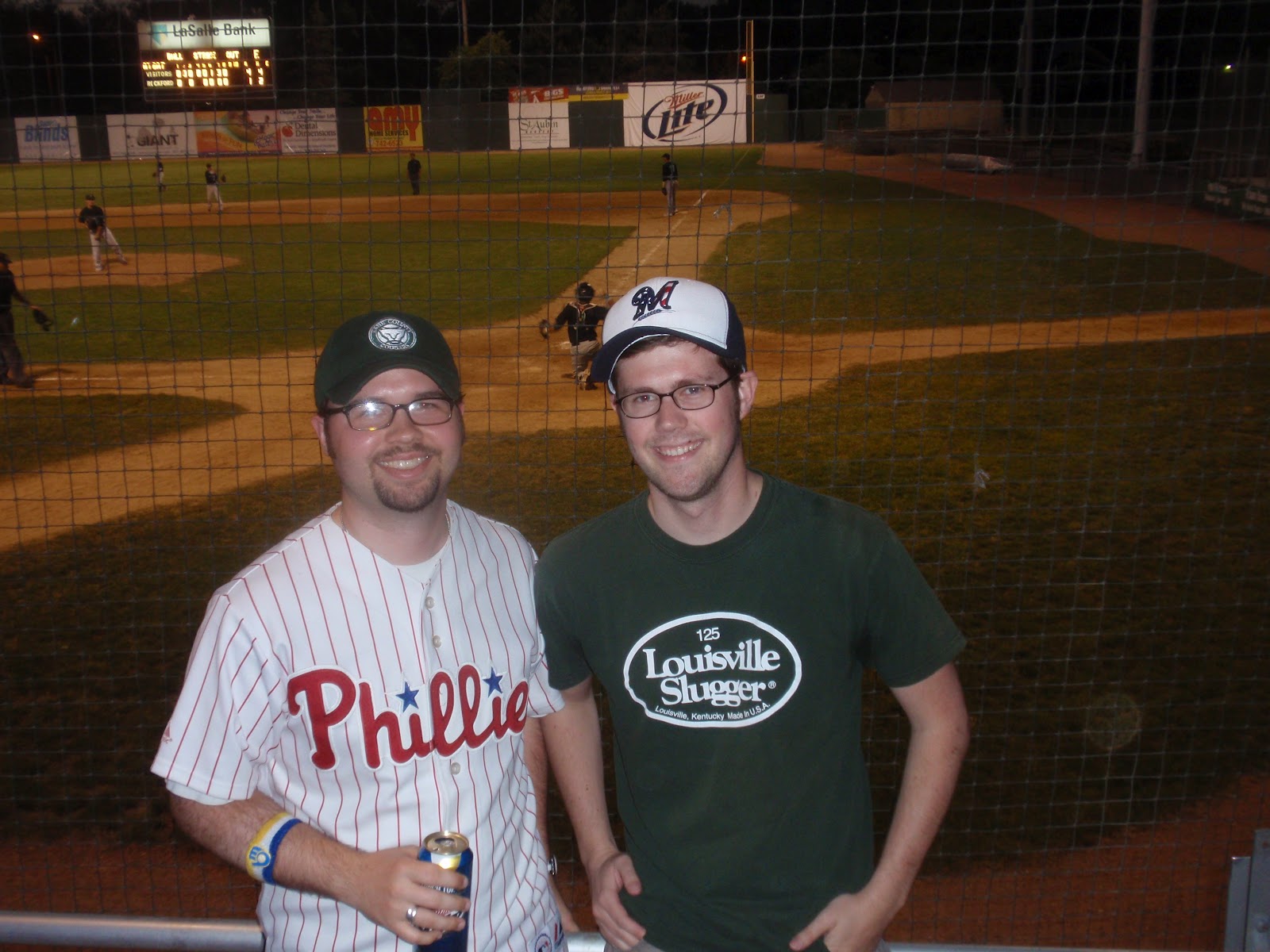


 touch with baseball when his childhood heroes Robin Yount, Paul Molitor, and Jim Gantner retired but the Great Home Run Chase of 1998 reignited his passion. As a student at the University of Wisconsin-Milwaukee, Erik became involved with the campus chapter of Habitat for Humanity. With this group Erik traveled to Portland, OR and Baltimore, MD to work on construction projects and help the group raise $25,000 to partially sponsor a house in Milwaukee. Also at UWM, Erik met Peter Nagel. The two attended their first Brewers game together during Opening Weekend 2003. Despite their failure to ignite the coals at their first tailgate, the two had a blast and were soon making weekly trips to the ballpark. Erik has gone on to several colleges and changed careers several times, and has moved all the way out to New Hampshire, but has always stayed true to his baseball roots by holding part-time stadium usher jobs. To this day he looks back fondly on his incredible cross-country journey.